
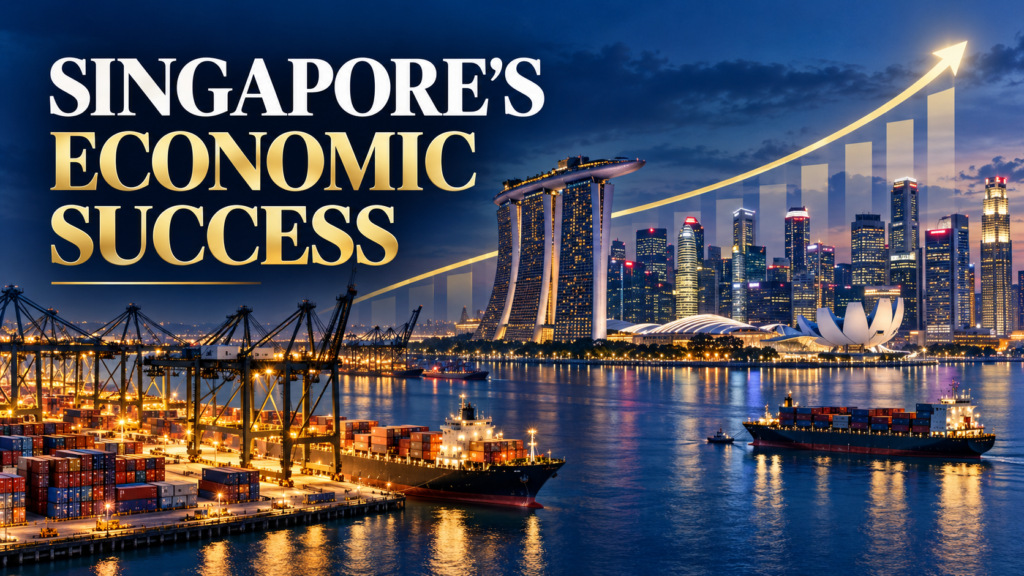
Singapore’s rise from a vulnerable trading port to one of the world’s most competitive economies is among the most remarkable development stories of the modern era. When the country became independent in 1965, it faced unemployment, limited land, few natural resources, and an uncertain economic future.
Instead of treating those limitations as permanent weaknesses, Singapore developed a long-term strategy built around trade, industrialization, education, infrastructure, and effective public institutions. The Singapore economic success story was not created by a single policy. It emerged from decades of disciplined planning and continuous adaptation.
The Difficult Starting Point After Independence
Singapore separated from Malaysia and became an independent nation in 1965. At that time, its leaders had to create jobs for a growing population while managing serious housing and infrastructure challenges.
The country did not possess large reserves of oil, minerals, or agricultural land. Its domestic market was also too small to support growth on its own. These conditions forced Singapore to look outward and build an economy connected to international trade.
Its strategic location along major shipping routes offered an important advantage. However, geography alone could not guarantee prosperity. Singapore needed reliable institutions, skilled workers, modern infrastructure, and international investment to turn its location into lasting economic value.
Singapore Adopted an Export-Oriented Strategy
Many developing economies initially focused on protecting local industries from foreign competition. Singapore followed a different path. It encouraged companies to manufacture products for international markets.
This export-oriented strategy allowed businesses based in Singapore to serve customers far beyond the country’s small population. It also connected the economy to global supply chains.
Manufacturing became an important source of employment. Early factories produced relatively simple products, but the country gradually moved toward electronics, chemicals, precision engineering, pharmaceuticals, and other higher-value industries.
By participating in global trade, Singapore gained access to capital, technology, management knowledge, and larger markets. Openness became one of the foundations of the Singapore economic success model.
The Government Attracted Foreign Investment
Singapore understood that domestic businesses alone could not provide all the capital, technology, and jobs required for rapid development.
The Economic Development Board, established in 1961, played a central role in attracting international companies. It promoted Singapore as a stable location where global businesses could manufacture products and manage regional operations.
The government did more than advertise the country. It developed industrial land, improved utilities, trained workers, and created policies that made long-term investment easier.
Foreign companies brought production expertise and access to international markets. Their investments created jobs and helped local workers acquire new technical and managerial skills.
Singapore’s approach worked because it tried to create benefits for both investors and the local economy. Businesses gained an efficient base in Asia, while Singapore gained employment, knowledge, and industrial capability.
Singapore Invested in World-Class Infrastructure
Modern infrastructure became another major pillar of Singapore’s transformation.
The country developed efficient ports, airports, roads, telecommunications networks, industrial estates, and public transportation. These systems reduced the time and cost required to move people, goods, and information.
The Port of Singapore became a major global shipping hub, while Changi Airport strengthened the country’s connections with international businesses and travelers.
Reliable electricity, clean water, efficient logistics, and digital connectivity gave companies confidence that their operations could function smoothly.
Infrastructure was not treated as a one-time project. Singapore continued upgrading its systems as technology and global business needs changed. This long-term approach helped the country remain competitive even as other economies developed similar capabilities.
Education and Workforce Skills Supported Growth
Economic development requires more than buildings and investment. Companies also need people with the right skills.
Singapore closely connected its education and training policies with the needs of the economy. As industries changed, schools and training institutions prepared workers for new types of jobs.
During the early stages of industrialization, the country needed workers for manufacturing. As the economy advanced, it placed greater emphasis on engineering, technology, finance, management, research, and professional services.
Technical education helped students develop practical skills, while continuous training allowed existing workers to adapt to changes in the labor market.
This connection between education and industry strengthened productivity. It also helped Singapore move from labor-intensive production toward higher-value activities.
Strong Institutions Built Business Confidence
Businesses are more willing to invest when rules are clear, contracts can be enforced, and public services operate efficiently.
Singapore developed a reputation for political stability, strong administration, and consistent economic policies. Its institutions focused on long-term planning and effective implementation.
The country also took corruption seriously. A transparent and predictable business environment reduced uncertainty for both local entrepreneurs and international companies.
Strong institutions did not remove every economic challenge, but they made it easier for businesses to plan, invest, and expand.
This institutional credibility became a competitive advantage. Companies could make long-term decisions with greater confidence because policies and regulations were generally understandable and consistently applied.
Public Housing Improved Social Stability
Singapore’s development strategy was not limited to attracting companies. The country also invested heavily in public housing and urban planning.
Large-scale housing programs helped move families into organized communities with access to transportation, schools, healthcare, and essential services.
Improved living conditions supported social stability and gave workers a stronger foundation for participating in the economy.
Home ownership also gave many households a direct stake in the country’s progress. Although Singapore’s housing model cannot simply be copied everywhere, it demonstrates how social policy and economic policy can support each other.
Singapore Continued Moving Into Higher-Value Industries
Low-cost manufacturing helped Singapore create jobs, but the country knew it could not rely on cheap labor forever.
As wages increased and competitors emerged, Singapore moved into more advanced industries. It developed capabilities in semiconductors, biotechnology, financial services, logistics, aerospace, digital technology, and professional services.
Manufacturing remained important, but its character changed. The focus shifted toward specialized production, research, automation, and activities requiring greater technical knowledge.
The services sector also expanded. Singapore became a regional center for finance, shipping, business management, and international trade.
This ability to change direction before an old economic model became ineffective was essential to the Singapore economic success story.
The Importance of Trade and Global Connections
Singapore’s domestic market remains small, so international connections are essential to its economy.
The country built an extensive network of trade agreements and maintained strong commercial relationships with economies across Asia, Europe, and North America.
Its location helped, but businesses also valued its infrastructure, legal system, skilled workforce, and ability to connect different markets.
Singapore positioned itself as a bridge between global companies and the rapidly growing Asian region. This role attracted regional headquarters, financial institutions, logistics companies, and technology businesses.
Challenges Facing Singapore’s Economy
Singapore’s achievements do not mean that its economic model is free from challenges.
The country is highly exposed to changes in global trade. Recessions, geopolitical tensions, supply-chain disruptions, and weaker international demand can affect its economy quickly.
Its population is aging, while land and labor remain limited. High living costs and economic inequality can also create pressure for households.
Competition from other Asian business hubs continues to increase. Singapore must therefore keep improving productivity, developing skills, and supporting innovation.
Environmental sustainability is another important challenge. A densely populated city-state must balance economic activity with energy security, climate resilience, and limited physical space.
What Other Countries Can Learn From Singapore
Singapore’s experience offers valuable lessons, but its policies should not be copied without considering local conditions.
The first lesson is that limitations can encourage strategic focus. Because Singapore lacked natural resources and a large domestic market, it concentrated on capabilities it could develop: skills, logistics, institutions, and global connections.
The second lesson is that execution matters. A strong plan creates little value if institutions cannot implement it consistently.
The third lesson is that education should evolve with the economy. Training people for disappearing industries does not create sustainable opportunity.
The fourth lesson is that infrastructure can become a national competitive advantage when it is reliable, efficient, and continuously improved.
Finally, economic policy must adapt. Singapore did not remain dependent on the industries that powered its early growth. It repeatedly moved toward more productive and knowledge-intensive activities.
The Singapore economic success model endured because its policies worked together instead of operating in isolation. Trade created opportunity, education developed skilled workers, and reliable institutions supported long-term investment. Singapore economic success also depended on reviewing old policies and adapting them as global conditions changed. This ability to improve continuously remains one of the strongest features of Singapore economic success.
Frequently Asked Questions
What caused Singapore’s economic success?
Singapore’s economic success came from a combination of export-oriented industrialization, foreign investment, strong institutions, modern infrastructure, workforce development, and continuous economic adaptation.
Did Singapore become successful only because of its location?
Its location along major trade routes was valuable, but location alone was not enough. Singapore converted that advantage into growth through efficient ports, reliable infrastructure, business-friendly institutions, and a skilled workforce.
Why did foreign companies invest in Singapore?
Companies were attracted by political stability, clear regulations, strong infrastructure, access to regional markets, and government support for investment and industry development.
What industries drive Singapore’s economy today?
Singapore has important capabilities in advanced manufacturing, electronics, finance, logistics, pharmaceuticals, professional services, digital technology, and international trade.
Can other countries copy Singapore’s economic model?
Countries can learn from Singapore’s focus on institutions, education, infrastructure, trade, and long-term planning. However, each country must adapt those lessons to its own population, geography, resources, and political conditions.
Conclusion
The Singapore economic success story shows how a small nation can build global influence through disciplined strategy and continuous improvement.
Singapore did not depend on natural resources. It invested in people, infrastructure, institutions, and international connections. It attracted foreign investment while steadily developing more advanced domestic capabilities.
Its transformation took decades and required difficult choices. The most important lesson is not that every country should copy Singapore exactly. It is that long-term planning, reliable execution, and the willingness to adapt can turn serious limitations into competitive strengths.

The Richalyze Editorial Team researches and explains how companies, markets, and economies work through clear analysis, real-world case studies, and practical business insights. Our goal is to make complex business and finance topics easier to understand through accurate, well-sourced, and reader-friendly content.
Pingback: AI Investment Boom 2026: Growth Engine or Bubble?