
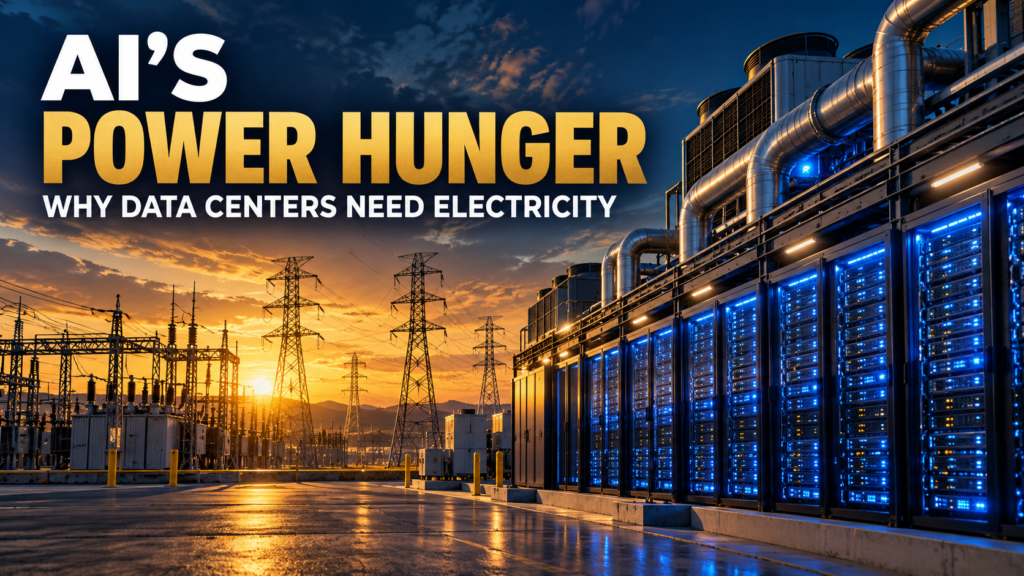
AI data center electricity demand is growing because artificial intelligence depends on physical machines. Every model trained, answer generated, and image created requires computing equipment—and that equipment needs power.
The electricity bill extends beyond the processors. Data centers also run memory, storage, networking equipment, cooling systems, and infrastructure that keeps services available.
Understanding this demand explains why the AI race increasingly involves power companies, electrical equipment suppliers, and local communities alongside technology businesses.
What Happens Inside an AI Data Center?
A data center houses computers and the supporting systems needed to operate them. Traditional facilities support activities such as websites, business software, and cloud storage. AI facilities often contain large clusters of specialized processors working together.
These processors perform calculations, move information through memory, and exchange data across networks. Packing more computing equipment into a facility can increase the amount of electricity it needs.
However, installed capacity is different from actual consumption. A facility’s electricity use depends on which machines are running, how heavily they are used, and how efficiently the building operates.
Why AI Data Center Electricity Demand Is Rising
AI creates demand through two main activities: training and inference.
Training Builds the Model
During training, computers process examples and repeatedly adjust a model’s internal parameters. Large training runs can involve many processors operating together for extended periods.
The electricity required varies with the model, hardware, training method, and number of experiments. Developing a useful model may involve several attempts rather than one successful run.
Inference Runs the Model
Inference happens when a trained model responds to a request. Examples include answering a question, generating an image, or analyzing a document.
One request may involve far less computing than an entire training run. However, a widely used service can process requests continuously. Its total inference workload can therefore become substantial.
There is no universal electricity cost for an “AI question.” A short text response and a lengthy video generation involve different workloads. Model size, response length, hardware, and system utilization also matter.
Cooling Adds to the Electricity Bill
Computing equipment releases heat while operating. Without adequate cooling, temperatures can rise beyond safe operating limits.
Facilities use different combinations of fans, pumps, chillers, and cooling equipment. Some move heat through air; others use liquid cooling close to the processors.
The International Energy Agency’s analysis of data center energy demand shows that cooling requirements vary substantially between facilities. Cooling is an additional load, but it should not automatically be described as the largest source of electricity consumption.
Liquid cooling can help manage dense computing equipment. Its overall performance still depends on the complete system, including how heat is removed from the building.
How Much Electricity Do Data Centers Use?
The IEA’s updated outlook projects global data center electricity consumption rising from approximately 485 terawatt-hours in 2025 to 950 terawatt-hours in 2030.
These figures cover data centers overall, including conventional computing. They should not be presented as electricity consumed exclusively by generative AI.
The 2030 figure is also a projection, rather than a guaranteed outcome. Demand will depend on adoption, equipment efficiency, infrastructure availability, and how businesses deploy AI.
Source: IEA — Key Questions on Energy and AI.
Why Grid Connections Matter
A developer can secure land and order servers while still facing a separate challenge: obtaining sufficient electrical capacity at the chosen location.
A large facility may require new substations, transformers, transmission capacity, or other upgrades. Building and connecting this infrastructure takes planning and coordination.
This creates a business constraint. Computing equipment cannot generate useful output without the power needed to operate it.
The U.S. Department of Energy’s recommendations on powering AI infrastructure examine how to support growing demand reliably and affordably while considering existing electricity customers and emissions.
For a data center developer, location decisions therefore involve more than land prices or tax incentives. Access to dependable electricity can affect when a project becomes operational.
Can Better Efficiency Solve the Problem?
Efficiency can reduce the electricity required for a given amount of useful computing. Improvements can come from processors, software, cooling, and better use of existing equipment.
One common facility metric is power usage effectiveness, or PUE. It compares the electricity used by the whole facility with the electricity used by its IT equipment.
For example, a hypothetical PUE of 1.2 means the facility consumes 1.2 units of electricity for every unit used by its IT equipment. The remaining 0.2 units support systems such as cooling and power delivery.
Google’s explanation of PUE illustrates how operators assess this facility overhead.
However, PUE does not measure the usefulness of the computing performed. A facility can have efficient cooling while running an unnecessarily expensive workload.
Total electricity consumption can also rise despite efficiency improvements if the amount of computing grows faster than the savings.
Electricity Use and Water Use Are Different
Electricity and water are related parts of data center operations, but they are different measurements.
Water use depends on cooling technology, local conditions, and other factors. Electricity generation can also involve water consumption outside the data center itself.
A facility that reduces direct water consumption may make different trade-offs in electricity use or equipment costs. Claims about environmental performance should therefore identify what is being measured and where.
The Department of Energy’s data center resource hub describes work on cooling efficiency and water reuse.
What This Means for Businesses
The business implication is that AI infrastructure requires coordinated investment across computing and energy systems.
Chip suppliers benefit when operators purchase more equipment. Utilities and electrical equipment manufacturers may face additional demand. Data center owners must balance construction costs, electricity expenses, customer demand, and operating efficiency.
These opportunities also carry risks. A project can disappoint if connections are delayed, costs increase, or customers require less capacity than expected.
For readers assessing the industry, useful questions include whether a project has secured power, when that power becomes available, and whether expected revenue can justify its operating costs.
Conclusion
AI data centers need substantial electricity because they combine intensive computing with supporting infrastructure. Training, inference, cooling, and power delivery all contribute.
Efficiency improvements can reduce the resources required for individual workloads. Whether they reduce total demand depends on how quickly the industry expands.
The next stage of AI growth will depend partly on how effectively businesses connect digital services with reliable physical infrastructure.
Frequently Asked Questions
Why do AI data centers need so much electricity?
They operate processors, memory, networking, storage, and supporting equipment. Cooling and power delivery add further electricity requirements.
Does every AI request consume the same energy?
No. Consumption varies with the model, task, output length, hardware, and how the service operates.
Is cooling always the biggest electricity expense?
No. Its share varies by facility. Computing equipment itself is a major source of electricity demand.
Will efficient chips eliminate the problem?
Efficient chips can reduce electricity per task, but total demand may still grow if businesses run many more tasks.
Related Reading
Explore how Nvidia makes money and how Starlink makes money for more examples of the physical infrastructure behind digital services.

Muhammad Umar Butt is the founder of Richalyze. He writes about company stories, business models, and finance, aiming to make complex topics easier to understand through clear explanations and real-world case studies.