
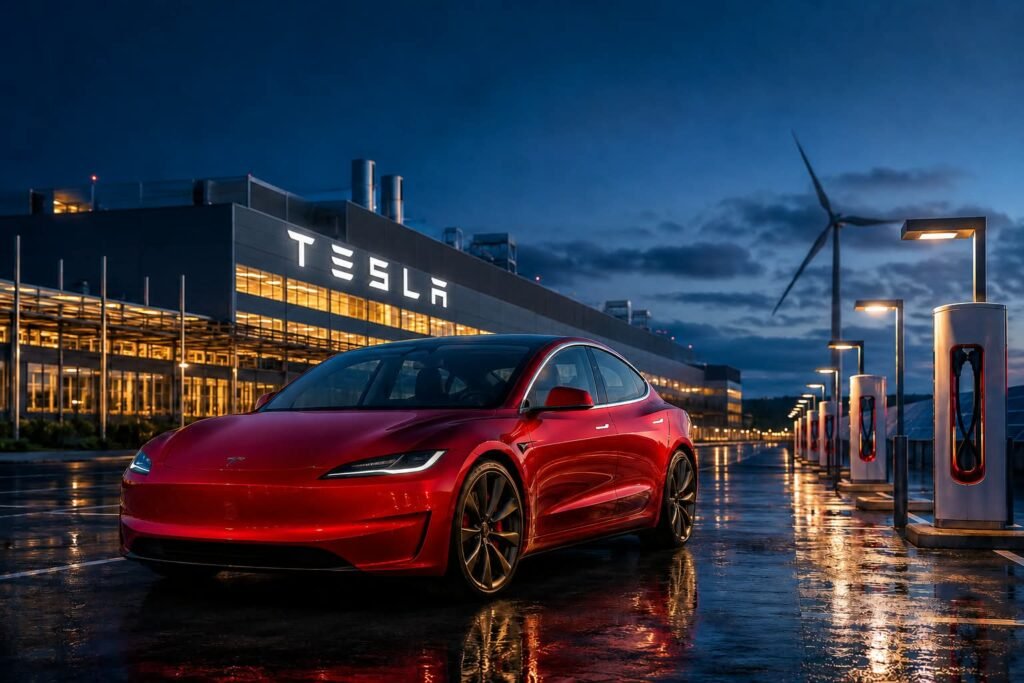
Tesla disrupted the auto industry by treating the electric vehicle as a better technology product—not merely an environmentally friendly alternative. Its direct-sales model, software-led vehicles, charging network, large factories, and aggressive approach to innovation forced established automakers to rethink their strategies.
How Tesla Disrupted the Auto Industry in One Sentence
Tesla disrupted the auto industry by combining electric powertrains, software, direct customer relationships, charging infrastructure, and large-scale battery manufacturing in one integrated business model.
The Auto Industry Before Tesla
To understand how Tesla disrupted the auto industry, it helps to examine the market it entered. For decades, the global automobile business was dominated by established manufacturers with extensive dealership networks, internal-combustion expertise, and large supply chains. Electric vehicles existed, but they were often viewed as slow, limited, or unsuitable for mainstream buyers.
Traditional automakers had built profitable businesses around gasoline-powered vehicles. Moving aggressively into electric vehicles required new battery expertise, manufacturing investments, software capabilities, and charging infrastructure. These challenges made rapid change difficult.
Tesla entered the market without the same legacy factories, dealer relationships, or gasoline-engine business to protect. That created enormous risk, but it also allowed the company to design its strategy around electric technology from the beginning.
The Roadster Changes the Electric-Car Image
Product innovation was central to how Tesla disrupted the auto industry. Tesla’s first production vehicle, the Roadster, challenged the belief that an electric car had to be slow or unexciting. Instead of entering the market with a basic economy car, Tesla used a premium sports car to demonstrate the performance potential of battery-powered vehicles.
This approach helped Tesla gain attention while learning about batteries, electric motors, vehicle software, and customer expectations. The Roadster was produced in relatively small numbers, but its strategic importance was much larger than its sales volume.
It gave Tesla a way to build credibility before attempting the far more difficult task of producing vehicles at greater scale.
Model S Makes Electric Vehicles Desirable
The Model S played an important role in how Tesla disrupted the auto industry. The Model S became a major turning point. It combined long-range electric driving with strong acceleration, a minimalist interior, a large touchscreen, and software features that felt different from traditional cars.
Tesla did not market the vehicle only around lower emissions. It presented the Model S as a premium product that could compete through performance, design, convenience, and technology.
This repositioning mattered. An electric vehicle was no longer simply a compromise for environmentally conscious buyers. It could be something customers wanted because of the driving experience itself.
Cars Become Software Platforms
This software-first strategy further shows how Tesla disrupted the auto industry. One of Tesla’s most influential ideas was to treat the vehicle as a software platform. Its cars were designed with connected systems and the ability to receive over-the-air software updates.
Traditional recalls and upgrades often required a visit to a dealership. Tesla demonstrated that some improvements, new features, and fixes could be delivered remotely. This made the ownership experience feel closer to using a smartphone or computer.
Software also became part of the product’s long-term value. Instead of considering the car complete on the day of purchase, Tesla could continue changing aspects of the experience after delivery.
Established automakers have since invested heavily in connected vehicles, software teams, digital services, and centralized computing systems. Tesla did not invent every underlying technology, but it accelerated the industry’s shift toward software-defined vehicles.
The Direct-Sales Model
The direct-sales model was another key way Tesla disrupted the auto industry. Tesla largely built its customer relationship through company-operated stores and online ordering rather than relying on the traditional franchised-dealer model.
This approach gave Tesla greater control over pricing, product presentation, customer information, and the buying process. Customers could configure and order a vehicle online without negotiating with an independent dealership.
Direct sales also created challenges. Tesla had to invest in its own delivery centers, service locations, customer support, and retail operations. Laws governing vehicle sales also vary across different markets.
Even with these limitations, Tesla showed that many customers were willing to purchase an expensive vehicle through a simpler, more digital process.
The Supercharger Network Solves a Customer Problem
An electric vehicle becomes less useful if drivers cannot charge it conveniently. Tesla recognized that selling cars and building charging infrastructure were connected problems.
The Supercharger network helped reduce concerns about long-distance travel by giving Tesla drivers access to fast-charging locations along important routes and in major destinations.
This was more than an additional service. It strengthened the value of owning a Tesla and made the company’s vehicles more practical. It also demonstrated that competition in electric vehicles would involve an entire supporting ecosystem—not just the car.
Tesla later opened parts of its charging network to vehicles from other manufacturers, while several automakers adopted its North American Charging Standard. This expanded Tesla’s influence beyond its own vehicle sales.
Gigafactories and Manufacturing Scale
Batteries are among the most important and expensive components in an electric vehicle. Tesla pursued large manufacturing facilities to increase production capacity and reduce costs through scale.
Its factory strategy expanded beyond vehicle assembly to include batteries, powertrains, energy-storage products, and related technologies. Tesla has developed manufacturing operations in the United States, China, and Germany.
Building factories at this scale is capital-intensive and operationally difficult. Production delays or quality problems can have serious financial effects. However, Tesla’s willingness to invest aggressively in capacity pushed the wider industry to secure batteries, redesign factories, and develop dedicated electric-vehicle platforms.
Model 3 and Model Y Expand the Market
The Model 3 represented Tesla’s attempt to reach a much larger customer base than its premium vehicles. Increasing production was difficult, but the vehicle became central to Tesla’s growth.
The Model Y later extended Tesla’s reach into the highly popular crossover segment. Together, the Model 3 and Model Y became the foundation of the company’s automotive volume.
Tesla reported producing approximately 1.60 million Model 3 and Model Y vehicles and delivering about 1.59 million during 2025. Across all models, the company reported approximately 1.64 million deliveries for the year.
These volumes showed that an electric-vehicle company could operate at a scale large enough to challenge major global automakers.
Price Pressure and Industry Competition
Tesla’s expansion encouraged established manufacturers and new competitors to accelerate their electric-vehicle plans. Consumers gained more choices, but Tesla also faced increasing pressure on pricing, market share, and profit margins.
The company reported total revenue of approximately $94.8 billion in 2025, down from about $97.7 billion in 2024. Automotive revenue declined, while energy generation and storage revenue increased.
This illustrates an important reality: disrupting an industry does not guarantee permanent dominance. Once competitors respond, the disruptor must continue improving products, costs, service, and technology.
More Than an Automobile Company
Tesla’s business also includes energy generation and storage products such as Powerwall and Megapack. In 2025, the company reported deploying 46.7 gigawatt-hours of energy-storage products.
Tesla reported approximately $12.8 billion in energy generation and storage revenue for 2025, an increase from roughly $10.1 billion in 2024. The segment’s growth shows how battery expertise can support businesses beyond passenger vehicles.
Tesla is also investing heavily in artificial intelligence, driver-assistance technology, computing infrastructure, and autonomous mobility. These projects may create future opportunities, but they involve significant technical, financial, and regulatory uncertainty.
Why Tesla’s Strategy Was Disruptive
- Electric-first design: Tesla built vehicles around electric powertrains instead of adapting gasoline-car platforms.
- Software integration: Connected systems and over-the-air updates became part of the ownership experience.
- Direct sales: Tesla controlled more of the customer journey through stores and online ordering.
- Charging infrastructure: The company addressed a major obstacle to electric-vehicle adoption.
- Manufacturing scale: Large factories supported vehicle, battery, and energy-product production.
- Strong brand identity: Tesla made electric vehicles desirable to performance- and technology-focused customers.
- Vertical integration: The company developed capabilities across software, powertrains, charging, manufacturing, and energy storage.
Risks and Challenges
Tesla faces intense competition from global automakers and fast-growing electric-vehicle manufacturers. Price reductions can increase demand but may also weaken margins.
The business is exposed to supply-chain disruption, raw-material costs, factory execution, regulation, product quality, and changing consumer demand. Tesla must also invest heavily in service capacity and charging infrastructure as its customer base grows.
Driver-assistance and autonomous-driving ambitions create additional safety and regulatory risks. Future results depend on technology that must work reliably in complex real-world conditions.
Leadership concentration and the public profile of CEO Elon Musk may also influence how customers, employees, investors, and regulators perceive the company.
Business Lessons from Tesla
Tesla’s story demonstrates that disruption often requires redesigning an entire customer experience rather than improving one feature. The company combined the vehicle, software, charging, ordering process, and brand into one system.
It also shows the value of entering a market with a clear point of difference. Tesla did not initially compete by offering another conventional car. It built a product around a different technology and made that difference central to its identity.
However, innovation must eventually be supported by manufacturing discipline, customer service, financial strength, and consistent execution. A bold idea can attract attention, but scaling it into a durable business is a separate challenge.
Final Takeaway
Tesla disrupted the auto industry by proving that electric vehicles could compete on performance, technology, design, and convenience. Its influence can be seen in the industry’s investments in dedicated electric platforms, software-defined vehicles, battery factories, direct digital sales, and charging networks.
The company now faces stronger competition and significant execution risks. Regardless of its future position, Tesla has already changed what customers expect from an electric vehicle and how automakers think about the future of transportation.
Sources
- Tesla — 2025 Annual Report
- Tesla — 2025 Production, Deliveries and Energy Deployments
- Tesla — Q2 2026 Production, Deliveries and Deployments
- Tesla — Q2 2026 Financial Results
- Tesla — Official Company News and Master Plans
- Related case study: How costco Makes Moneyhttps://richalyze.com/how-costco-makes-money-its-business-model-explained/

The Richalyze Editorial Team researches and explains how companies, markets, and economies work through clear analysis, real-world case studies, and practical business insights. Our goal is to make complex business and finance topics easier to understand through accurate, well-sourced, and reader-friendly content.
Pingback: Apple Comeback: 5 Powerful Lessons from Its Revival