
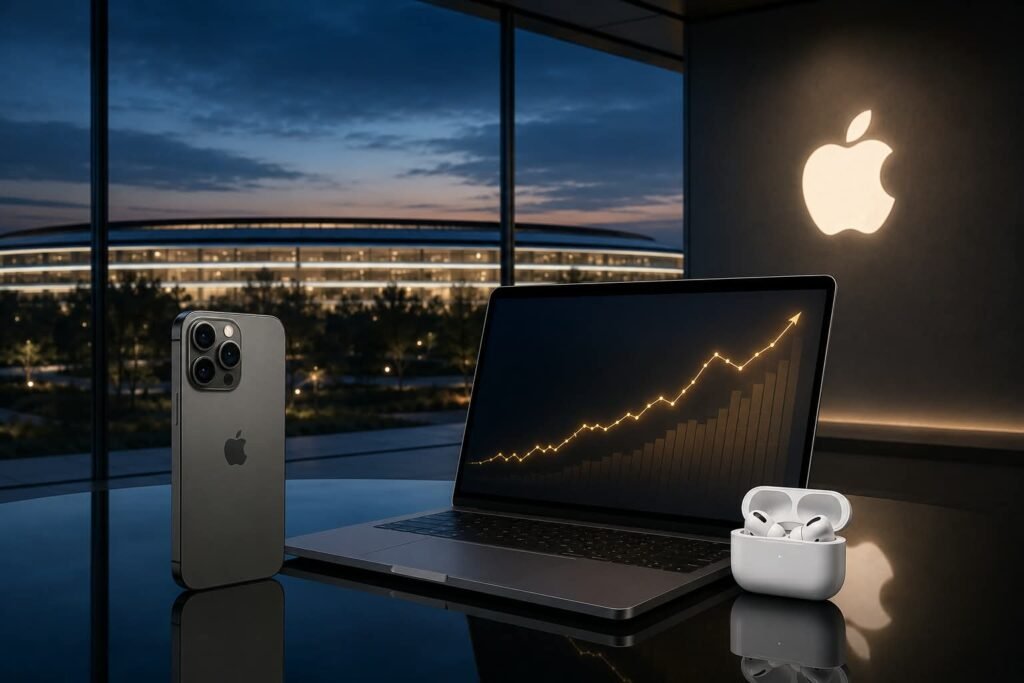
The Apple comeback is one of the most remarkable turnarounds in business history. The company recovered by simplifying its product lineup, rebuilding its brand, creating breakthrough devices, and developing an ecosystem that keeps customers connected to its products and services.
The Apple Comeback in One Sentence
The Apple comeback transformed the company from a struggling computer maker into a global technology leader by combining focused leadership, distinctive design, tightly integrated hardware and software, and a growing ecosystem of devices and services.
Apple Before the Comeback
Understanding these problems helps explain why the Apple comeback became so remarkable.
During the 1990s, Apple faced a serious strategic problem. Its product lineup had become complicated, competition from Windows-based computers was intense, and the company lacked a clear direction. Apple still had valuable technology and loyal customers, but its business needed greater focus.
The company’s challenge was not simply to introduce another computer. It needed to decide what Apple should represent, which customers it should serve, and how its products could stand apart in a crowded market.
Steve Jobs Returns and Simplifies the Business
Steve Job’s return became a defining moment in the Apple comeback. Steve Jobs returned to Apple in 1997 after Apple acquired NeXT, the technology company he had founded after leaving Apple. His return brought a sharper product strategy and a renewed emphasis on simplicity.
Apple reduced its confusing range of computers and concentrated on a smaller number of important products. This focus allowed its teams to direct more time, money, and talent toward products that could make a meaningful difference.
The lesson was powerful: a company does not always recover by doing more. Sometimes it recovers by eliminating distractions and doing fewer things exceptionally well.
The iMac Rebuilds Apple’s Identity
The iMac gave the Apple comeback a clear visual identity. The iMac, introduced in 1998, helped restore excitement around the Apple brand. At a time when many personal computers looked similar, the iMac used a distinctive all-in-one design and emphasized ease of use.
Its importance went beyond sales. The iMac showed that computers could be approachable, attractive, and part of a customer’s lifestyle. Apple was beginning to compete through the complete user experience rather than technical specifications alone.
This design-led approach became a central part of Apple’s future strategy. Products, packaging, software, stores, and advertising would all communicate the same clear brand identity.
The iPod Expands Apple Beyond Computers
The iPod became another major milestone in the Apple comeback. Apple introduced the original iPod in October 2001. According to Apple, it placed up to 1,000 songs and as much as 10 hours of battery life in a compact music player.
The iPod was important because it expanded Apple beyond the personal-computer market. Combined with iTunes and the iTunes Store, it offered customers a convenient way to manage, purchase, and enjoy digital music.
By April 2007, Apple announced that it had sold its 100 millionth iPod. The device strengthened Apple’s brand, introduced the company to millions of new customers, and demonstrated the value of connecting hardware, software, and digital content.
The iPhone Changes Apple’s Future
In January 2007, Apple unveiled the iPhone as a combination of a mobile phone, a widescreen iPod, and an internet communications device. Its multi-touch interface replaced many physical buttons with software-controlled interactions.
The iPhone became much more than a successful product. It created a platform around which Apple could build applications, services, accessories, and future devices. Developers gained access to a large customer base, while customers gained access to an expanding range of useful apps.
This created a network effect: more customers attracted more developers, more applications made the iPhone more useful, and the stronger ecosystem attracted even more customers.
Apple Builds an Integrated Ecosystem
Apple’s competitive advantage is not based on one device alone. The company designs products that work together across a connected ecosystem.
An iPhone can connect with a Mac, iPad, Apple Watch, AirPods, iCloud, Apple Music, Apple Pay, and other Apple services. Features such as device syncing and shared accounts reduce friction for customers who use several Apple products.
This integration can increase customer loyalty because the value of each product grows when it is used with other products in the ecosystem. A competing device must therefore replace not only one Apple product but also some of the convenience created by the wider system.
Premium Products and Brand Loyalty
Apple generally competes through product quality, design, privacy, convenience, and brand trust rather than trying to offer the lowest price.
This premium positioning supports healthy margins and gives Apple resources to invest in research, custom chips, software, retail stores, supply-chain capabilities, and customer support.
Apple’s physical and online stores also give the company direct contact with customers. It can control how products are presented, provide technical assistance, and collect valuable feedback about the customer experience.
Services Create Recurring Revenue
Apple gradually expanded from a business driven mainly by device sales into one supported by a large services operation. Its services include the App Store, iCloud, Apple Music, Apple TV, AppleCare, advertising, and payment-related offerings.
Services can generate recurring revenue and keep customers active within the Apple ecosystem between major hardware purchases. They also allow Apple to earn revenue from its installed base of devices over longer periods.
Apple reported that its installed base exceeded 2.5 billion active devices in its fiscal first quarter of 2026. In the quarter ended June 27, 2026, Apple reported total net sales of approximately $109.4 billion, including about $30.7 billion from Services.
These figures show how Apple’s business now combines large product sales with a substantial and growing services operation.
Tim Cook Strengthens Apple’s Scale
When Tim Cook became CEO in 2011, Apple already had several category-defining products. Under his leadership, the company expanded its global scale, strengthened its supply chain, developed its services business, introduced additional product categories, and increased its investment in custom silicon.
Apple-designed chips have allowed the company to optimize performance, efficiency, and software integration across its devices. This reinforces the same strategy that powered the comeback: controlling important parts of the customer experience instead of depending entirely on outside technology.
Why Apple’s Comeback Worked
- Focus: Apple reduced unnecessary complexity and concentrated on fewer major products.
- Design: It treated appearance and ease of use as important business advantages.
- Integration: Hardware, software, and services were designed to work together.
- Innovation: Products such as the iPod and iPhone opened major new markets.
- Brand consistency: Products, stores, advertising, and support delivered a recognizable experience.
- Ecosystem growth: Each additional device or service increased the value of the wider platform.
- Recurring revenue: Services reduced Apple’s dependence on individual product launches.
Risks Apple Still Faces
Apple’s success does not remove business risk. The company remains heavily dependent on the iPhone, operates a complex global supply chain, and faces intense competition across hardware, software, artificial intelligence, and digital services.
Regulatory scrutiny of app distribution, platform rules, and service fees may also affect parts of its business model. Apple must continue creating products that customers consider valuable enough to justify premium prices.
Business Lessons from Apple’s Turnaround
Apple’s story offers several lessons for entrepreneurs and business leaders. Clear positioning is often more valuable than a large but confusing range of products.
A strong product should solve a real customer problem while delivering a simple experience. Businesses can also become more resilient by building an ecosystem, recurring revenue, and direct customer relationships.
Most importantly, a turnaround requires more than a temporary sales increase. It requires a strategy that strengthens the company over time. Apple achieved that by connecting focused product development with design, technology, distribution, and customer loyalty.
Final Takeaway
Apple’s historic comeback was not the result of a single invention. It was a sequence of disciplined decisions: simplify the company, rebuild the brand, create breakthrough products, connect them through an ecosystem, and add recurring services around a large installed base.
That combination turned Apple’s recovery into a durable business transformation—and made its comeback one of the most influential case studies in modern corporate history.
Sources
- Apple — The Music Lives On
- Apple — 100 Million iPods Sold
- Apple — Apple Reinvents the Phone with iPhone
- Apple — Fiscal 2026 First-Quarter Results
- Apple — Fiscal 2026 Third-Quarter Financial Statements
- Related case study: How Tesla Disrupted the Auto Industry

The Richalyze Editorial Team researches and explains how companies, markets, and economies work through clear analysis, real-world case studies, and practical business insights. Our goal is to make complex business and finance topics easier to understand through accurate, well-sourced, and reader-friendly content.
Pingback: How Costco Makes Money: 5 Powerful Business Secrets
Pingback: 6-Step LEGO Turnaround Strategy That Beat Bankruptcy