
Custom AI chips are becoming an important part of how major technology companies build and operate artificial intelligence services.
Google, Amazon, Microsoft, and Meta all have custom silicon programs. Their goals include matching hardware to specific workloads, improving operating economics, and gaining more control over infrastructure.
However, designing a processor does not make a company independent of the semiconductor industry. Successful deployment still requires manufacturing partners, memory, networking, software, and reliable electricity.
The business story is about optimizing an entire computing system—and deciding when the benefits justify the investment.
What Are Custom AI Chips?
Custom AI chips are processors designed around particular artificial intelligence requirements. They can accelerate the calculations and data movement involved in training models or running them after training.
Training adjusts a model using examples. Inference uses a trained model to produce an answer, recommendation, image, or other output.
These activities have different requirements. A design suited to one workload may be less attractive for another.
“Custom” also does not necessarily mean designed without partners or manufactured in a company-owned factory. Companies can work with specialist semiconductor businesses while tailoring hardware to their own infrastructure.
Which Companies Are Developing Custom AI Chips?
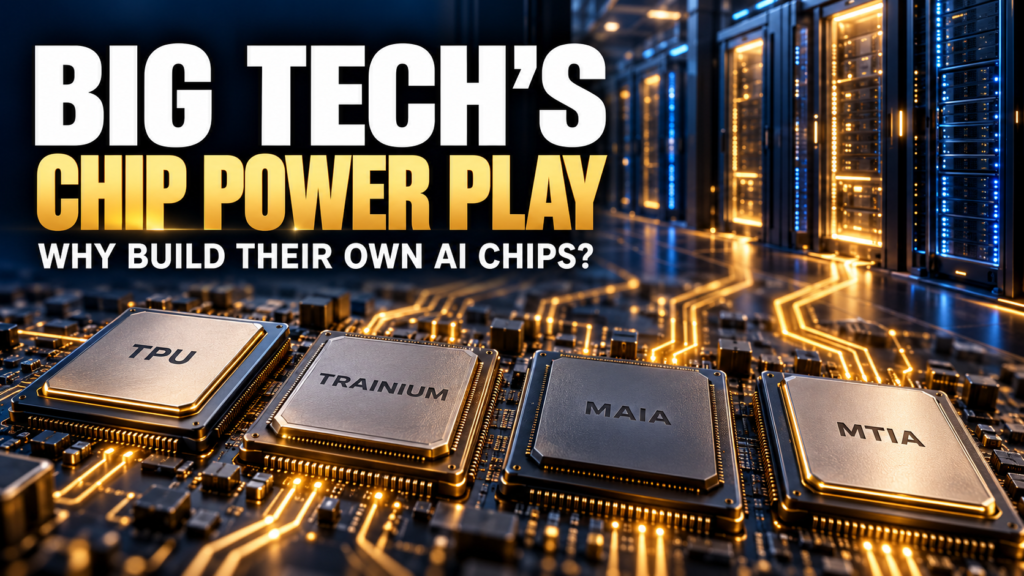
Several major technology businesses have established accelerator families:
| Company | Chip family | Role described by the company |
|---|---|---|
| TPU | Accelerating AI training and inference | |
| Amazon Web Services | Trainium and Inferentia | Supporting training and inference workloads |
| Microsoft | Maia | Accelerating AI inference |
| Meta | MTIA | Supporting recommendations, ranking, and broader AI workloads |
Google describes its Tensor Processing Units as custom accelerators integrated with its broader AI infrastructure.
AWS positions Trainium around training and inference economics, while Inferentia targets inference.
Microsoft’s October 2026 Maia update states that Maia 200 is serving production workloads and outlines expansion plans.
Meta’s MTIA partnership with Broadcom involves co-developing multiple generations of custom silicon.
These programs differ in maturity, availability, and intended use. They should not be treated as interchangeable products.
1. Custom AI Chips Can Improve Cost per Task
The relevant business question is how much it costs to produce useful computing output.
A processor’s purchase price is only one component. Electricity, cooling, networking, software engineering, maintenance, and utilization also affect overall economics.
Consider a hypothetical service processing millions of similar requests. Even a modest reduction in cost per request could become meaningful at that scale.
However, savings must exceed the cost of developing and deploying the alternative system. A cheaper chip can still be an expensive choice if software work is substantial or equipment sits underused.
The financial appeal of custom AI chips therefore depends on the workload and deployment—not merely the hardware label.
2. Specialized Hardware Can Match Specific Workloads
A broad-purpose accelerator must accommodate many customers and applications. A company operating its own large service may understand a narrower set of requirements particularly well.
It can potentially coordinate processor design with model architecture, memory needs, and networking.
For example, Microsoft describes Maia 200 as an inference accelerator with a design focused on computation and data movement. Its technical introduction explains the role of its memory system alongside processing capability.
This illustrates why peak computing performance alone is insufficient. A processor also needs timely access to data.
Specialization brings a trade-off: hardware optimized for today’s requirements may become less attractive if future models behave differently.
3. Owning More of the Design Gives Companies Control
Custom AI chips can give operators greater influence over hardware development schedules and system priorities.
A company may want a particular balance of memory capacity, energy efficiency, response time, and networking performance. Participating in design allows it to shape those decisions more directly.
That does not eliminate external dependencies.
Meta’s Broadcom partnership, for instance, spans chip design, advanced packaging, and networking. The arrangement demonstrates how custom hardware can involve close collaboration across several businesses.
As a business interpretation, these programs can expand an operator’s options. They do not guarantee unlimited supply or complete control over production.
4. Efficiency Matters When Power Is Limited
Electricity is both an operating expense and a practical infrastructure constraint.
If a system completes more useful work with the same available power, an operator may be able to serve more demand without a proportional increase in electricity consumption.
But comparisons need care. Different precision settings, model sizes, response requirements, and utilization levels can change results.
A vendor’s performance claim should therefore be evaluated against the specific workload and testing conditions.
Custom AI chips may improve efficiency in suitable applications. That does not mean every deployment uses less electricity overall: total consumption can still increase as the amount of computing grows.
5. Custom Hardware Can Differentiate Cloud Services
For a cloud provider, custom AI chips can become part of the service offered to customers.
Google makes TPUs available through its cloud platform. AWS offers infrastructure built around its own accelerators.
The opportunity extends beyond renting access to a processor. Customers also need software, networking, storage, and tools for operating their applications.
A useful hardware option can strengthen that broader offering. However, customers will consider migration effort, reliability, availability, and total cost alongside advertised performance.
The strongest commercial case is a system that customers can use productively.
Why Software Is Essential
A capable processor needs software that developers can work with.
Compilers translate programs into instructions the hardware can execute. Libraries provide common operations. Monitoring and debugging tools help teams understand performance and failures.
AWS Neuron is an example of a developer stack built for Trainium and Inferentia, including a compiler, runtime, libraries, and development tools.
This is why custom AI chips are also a software investment.
If a business must spend months adapting an application, those costs affect the value of switching. Compatibility and developer experience can be as important commercially as the processor itself.
Do Custom Chips Mean Nvidia Will Disappear?
That conclusion goes beyond the evidence.
Meta explicitly describes a diversified approach to computing, combining custom silicon with external suppliers. Its infrastructure overview discusses MTIA alongside partnerships with Nvidia, AMD, and other companies.
Different workloads can justify different hardware choices. Operators may prioritize flexibility for some tasks and specialization for others.
The reasonable business interpretation is that custom silicon expands competition and purchasing options. It does not establish that one architecture will replace every alternative.
The Risks Behind Custom AI Chips
Developing hardware requires substantial technical work before its commercial value is clear.
Projects can face delays, software difficulties, manufacturing constraints, or changing customer requirements. A design can also deliver strong technical results while failing to generate sufficient financial savings.
Readers assessing these programs should ask:
- Is the hardware operating in production?
- Which workloads does it support?
- Do savings include migration and operating costs?
- Is there evidence of sustained utilization?
- Are future deployments confirmed or still planned?
These questions help separate an announcement from a successful business outcome.
Conclusion
Custom AI chips offer major technology companies a way to shape the cost, efficiency, and capabilities of their computing infrastructure.
The opportunity comes from coordinating hardware with workloads and software at significant scale. The challenge is making that coordination economically worthwhile.
Success depends on useful output, dependable operation, and sustainable costs across the complete system.
Frequently Asked Questions
What are custom AI chips?
They are processors tailored to particular artificial intelligence workloads, such as training, inference, or recommendation systems.
Why does Big Tech design its own chips?
Companies seek better workload fit, operating efficiency, infrastructure control, and differentiated services. Benefits depend on successful execution.
Do these companies manufacture every chip themselves?
No. Custom design can involve semiconductor partners and external manufacturing services.
Are custom AI chips always cheaper than GPUs?
No. The answer depends on performance requirements, software effort, utilization, and total operating costs.
Related Reading
Explore how Nvidia makes money and how Meta makes money to understand the suppliers and customers shaping AI infrastructure.

Muhammad Umar Butt is the founder of Richalyze. He writes about company stories, business models, and finance, aiming to make complex topics easier to understand through clear explanations and real-world case studies.