
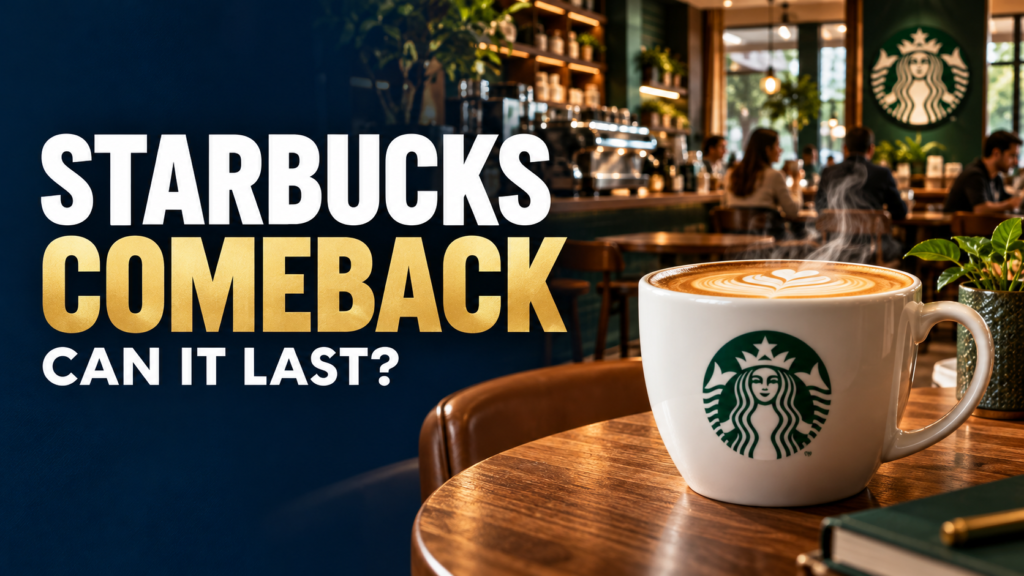
The Starbucks turnaround is about restoring something customers once expected from every visit: good coffee, reliable service and a welcoming place to spend time.
A globally recognized brand can attract attention, but the everyday experience determines whether people return. Starbucks is rebuilding that experience through its “Back to Starbucks” strategy.
By October 2026, its reported results showed meaningful progress. However, stronger performance does not mean every challenge has disappeared. The next test is whether the improvements can last.
Research updated October 25, 2026.
Why Starbucks Needed a Turnaround
Starbucks sells more than beverages. Its business also depends on convenience, familiarity and the atmosphere inside its coffeehouses.
That makes execution especially important. A disappointing visit can weaken the value customers associate with the brand, even when they still recognize its name.
In his September 2026 review, chairman and chief executive officer Brian Niccol acknowledged that coffeehouses had needed more warmth, service had needed greater consistency, and employees had needed better support.
The company’s response included improved staffing and scheduling, updated service routines and changes intended to make cafés more inviting.
Source: Starbucks’ two-year strategy review. about.starbucks.com
What Is the Starbucks Turnaround Strategy?
The central idea behind Back to Starbucks is to make the coffeehouse experience a stronger reason to visit.
The strategy brings together customer service, store design, product development and operating discipline. These elements must work together: attractive cafés cannot compensate indefinitely for unreliable service, and fast service alone does not create a distinctive brand.
1. Improve Service Inside the Coffeehouse
Starbucks has made Green Apron Service a central part of its operating approach.
At its January 2026 Investor Day, the company reported that the model had been rolled out across North American company-operated coffeehouses. Management associated it with improvements in service times, throughput and customer satisfaction.
Richalyze analysis: Better service can support growth in two ways. It can make an individual visit more satisfying and increase a store’s ability to serve customers during busy periods.
The challenge is maintaining that standard across locations and different ordering channels.
Source: Starbucks’ 2026 Investor Day update. about.starbucks.com
2. Make Stores Worth Spending Time In
A coffeehouse needs to offer customers a reason to stay as well as a convenient way to collect a drink.
Starbucks describes its turnaround as a return to high-quality beverages, customer service and human connection. Its September 2026 progress review emphasized restoring a warm, welcoming atmosphere while supporting employees.
Richalyze analysis: This approach addresses an important business question: what makes the experience worth choosing over another café?
Comfort, consistency and personal service can help differentiate a business when customers have many alternatives.
Source: Back to Starbucks: Two years of progress. about.starbucks.com
3. Be Selective About the Store Portfolio
Recovery does not require keeping every existing location open.
In September 2026, Starbucks announced plans to close approximately 250 North American coffeehouses. The company said those locations either could not consistently deliver its intended experience or lacked a path to acceptable financial performance.
It also said it was accelerating toward 1,500 coffeehouse upgrades.
These decisions illustrate two different uses of capital: improve locations with potential and withdraw from locations that do not meet the company’s standards.
Source: Starbucks’ coffeehouse portfolio update. about.starbucks.com
Is the Starbucks Turnaround Working?
The company’s fiscal third-quarter results provided evidence of improvement.
For the quarter ended June 28, 2026:
- Global comparable-store sales increased 7.9%.
- Comparable transactions increased 4.2%.
- Average ticket increased 3.5%.
- Consolidated revenue decreased approximately 1% to $9.3 billion.
The revenue decline needs context. Starbucks’ transition of its China retail operations to a licensed joint-venture model changed how that business appeared in its consolidated financial results.
Comparable-store sales and consolidated revenue measure different things. They should not be treated as interchangeable indicators of customer demand.
The quarter showed stronger activity at comparable stores, while the accounting scope of the overall business also changed.
Source: Starbucks’ fiscal third-quarter 2026 results. investor.starbucks.com
What Could Still Challenge the Recovery?
Richalyze analysis: Several practical risks remain.
Keeping Service Consistent
A successful turnaround must become a repeatable operating standard. Customers judge their own store and their own order, rather than the company’s average performance.
Delivering Value
Customers consider the complete experience when deciding whether a purchase feels worthwhile. Product quality, convenience and service all contribute to that judgment.
Balancing Investment and Profitability
Staffing, store improvements and product development require resources. Those investments need to support lasting customer demand and healthy store economics.
Maintaining Momentum
Improvement across several quarters is more persuasive than one strong period. A durable recovery requires customers to keep returning after the initial changes.
Business Lessons From Starbucks
The Starbucks turnaround offers a useful lesson for other consumer businesses: reconnecting with the original customer promise can be more valuable than adding complexity.
A brand must understand what people expect from it, identify where the experience has weakened and make practical improvements employees can deliver consistently.
Another lesson concerns expansion. More locations are useful only when those locations strengthen the business. Store quality and economics matter alongside store count.
For another example of a company refocusing its business, read LEGO’s turnaround strategy. You can also explore why Nokia lost the smartphone race to see how changing customer expectations can challenge an established leader.
Final Takeaway
Starbucks has reported meaningful progress in its recovery. Its strategy focuses on improving the coffeehouse experience, supporting employees and managing its store portfolio more carefully.
The strongest evidence of a lasting comeback will be consistent service, repeat customer visits and sustainable profitability over time.
Frequently Asked Questions
What is the Starbucks turnaround strategy?
Back to Starbucks focuses on coffee quality, customer service, welcoming coffeehouses and more disciplined operations.
Is Starbucks showing signs of recovery?
Yes. Its fiscal third-quarter 2026 results showed higher comparable-store sales and transaction growth. Continued performance will determine how durable that progress becomes.
Why is Starbucks closing some stores?
The company identified locations that could not deliver its intended customer experience or lacked a path to acceptable financial performance.
Why can comparable sales rise while total revenue falls?
Comparable sales measure performance within a defined group of existing stores. Total revenue also reflects changes in ownership structure, the store portfolio and other business activities.

Muhammad Umar Butt is the founder of Richalyze. He writes about company stories, business models, and finance, aiming to make complex topics easier to understand through clear explanations and real-world case studies.