
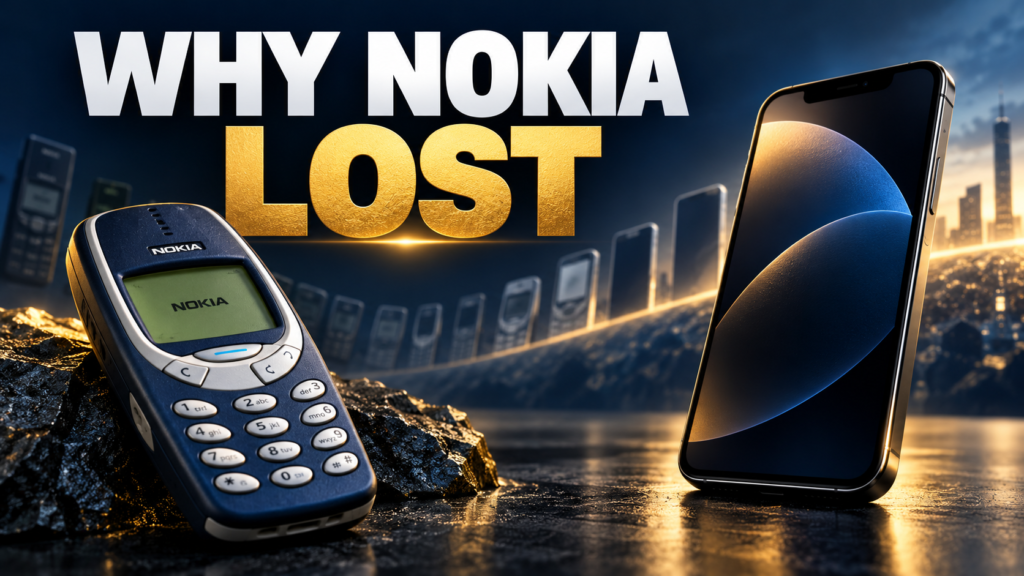
Before smartphones became everyday companions, Nokia was one of the most recognizable names in mobile technology. For many people, a Nokia handset was their first mobile phone.
Yet the company that helped popularize mobile communication eventually lost its position in smartphones.
Why did Nokia fail to defend its lead? The explanation involves a changing market, software competition and a difficult platform transition. However, losing its handset business did not mean Nokia disappeared.
Its story shows how a successful company can lose one market while continuing to operate in another.
How Nokia Became a Mobile Phone Leader
Nokia’s history stretches back to a Finnish paper mill founded in 1865. Over time, the company operated across several industries before concentrating on telecommunications.
By 1998, Nokia had become the world’s leading mobile phone company, a position it maintained for more than a decade, according to its corporate history. nokia.com
Its strengths suited the mobile phone market of that period: recognizable products, manufacturing scale and broad distribution.
Those strengths helped Nokia reach customers across different countries and price ranges. But the next stage of mobile competition would demand more than the ability to manufacture and distribute phones.
Why Nokia Failed to Keep Its Smartphone Lead
The central problem was a shift in what made a phone valuable.
Consumers increasingly judged smartphones by their software experience, browsing capabilities and available applications. Manufacturers also needed developers and service providers to support their platforms.
Nokia had smartphone technology. The challenge was turning its capabilities into a competitive platform quickly enough.
1. The iPhone Changed Customer Expectations
Apple introduced the iPhone in January 2007, combining a phone, media player and internet device with a large multi-touch interface. Apple
The strategic implication was significant: software and interaction design could become major reasons to choose a phone.
A manufacturer could produce capable hardware and still struggle if customers preferred a rival’s overall experience. Nokia faced the task of adapting while protecting an enormous existing business.
2. Symbian Lost Competitiveness
Nokia’s own 2011 annual report describes deteriorating demand for Symbian smartphones.
The company reported pressure on sales, profitability and market share as competitors took advantage of its transition between platforms. It also acknowledged that changing market conditions weakened Symbian’s competitiveness. nokia.com
This matters because Nokia’s decline is sometimes reduced to a claim that it simply ignored smartphones.
The evidence points to a more complicated problem: it was already competing in smartphones, but its existing platform was losing ground while the replacement strategy was still developing.
3. Its Microsoft Partnership Created a Difficult Transition
In February 2011, Nokia and Microsoft announced a partnership that would make Windows Phone Nokia’s principal smartphone platform.
The plan combined Nokia’s device expertise with Microsoft’s software and developer tools. It also aimed to integrate services such as mapping and application distribution.
The companies’ announcement explicitly identified risks, including whether developers would support the platform and whether the partnership could deliver competitive products quickly enough. Source
Nokia launched its first Lumia Windows Phone devices in October 2011. Meanwhile, demand for its Symbian products was weakening. nokia.com
Our analysis: Nokia needed to manage two challenges at once—supporting a declining platform and building demand for a new one. That made execution especially difficult.
4. A Strong Brand Could Not Guarantee Platform Success
The partnership’s ambition went beyond selling attractive devices. Nokia and Microsoft wanted to build an ecosystem involving customers, developers, operators and services.
That distinction explains an important business lesson. A familiar brand can help a product attract attention, but customers still need compelling reasons to adopt—and remain within—its platform.
Nokia’s hardware reputation could not, by itself, solve every challenge facing Windows Phone.
What Happened to Nokia’s Phone Business?
In September 2013, Nokia announced a transaction to sell substantially all of its Devices & Services business to Microsoft.
The sale closed on April 25, 2014. Nokia’s completion announcement referred to an earlier agreed transaction price of €5.44 billion, subject to closing adjustments. nokia.com
Microsoft acquired the handset operation, rather than the entire Nokia company.
In July 2015, Microsoft announced a major restructuring and an expected impairment charge of approximately $7.6 billion related to assets associated with the acquisition. Source
An impairment is an accounting reduction in an asset’s recorded value. It should not be confused with an equivalent cash payment made on that announcement date.
Did Nokia Go Out of Business?
No. Nokia continued after selling its handset operation.
Following the transaction, its continuing businesses included networks, mapping and technology licensing. That distinction is essential when discussing “Nokia’s failure”: the smartphone setback was not the end of the corporation. sec.gov
What Does Nokia Do Today?
Nokia now focuses on communications infrastructure and associated technology.
Its operating structure changed on January 1, 2026, to two primary segments:
| Segment | Main activities |
|---|---|
| Network Infrastructure | Optical networks, IP networks and fixed networks |
| Mobile Infrastructure | Core software, radio networks and technology standards |
These activities support the networks that connect users, organizations and digital services. Technology licensing also forms part of this business. nokia.com
Business Lessons from Nokia’s Decline
The following are our conclusions from the case:
- Watch how customers define value. A market leader must recognize when buying decisions shift toward new capabilities.
- Treat transitions as execution problems. Choosing a new strategy is only the beginning; customers and partners must move with it.
- Separate brand strength from competitive advantage. Recognition helps, but it does not guarantee a winning product.
- Distinguish a business unit from the whole company. Losing one market does not necessarily eliminate the value of other operations.
Final Takeaway
Nokia lost its smartphone leadership during a major change in mobile technology. Its software position weakened, and the transition to Windows Phone failed to restore its former standing.
But Nokia continued beyond handsets.
Its story is both a warning about adapting to changing competition and an example of how a company can build its future around a different part of its business.
Frequently Asked Questions
Why did Nokia fail in smartphones?
Nokia struggled with declining Symbian competitiveness and a difficult transition to Windows Phone as smartphone competition changed.
Did Microsoft buy all of Nokia?
No. The 2014 transaction involved substantially all of Nokia’s Devices & Services business, not the whole company.
Is Nokia still operating?
Yes. Nokia continues as a communications infrastructure and technology company.
Read more: Apple’s comeback and LEGO’s turnaround.

Muhammad Umar Butt is the founder of Richalyze. He writes about company stories, business models, and finance, aiming to make complex topics easier to understand through clear explanations and real-world case studies.